Tell us about the job
Takes about a minute. No obligation.
A short, sharp cooling season asks the compressor to start and stop repeatedly through the hottest weeks of the year, and the contactor and capacitor absorb most of that stress. Homes in Treasure County, MT run cooling about two months a year, from July through August. Because the system sits idle the rest of the year, a fault can develop during shutdown and stay hidden until the first hot day the following July. A contractor repairing a unit here checks the starting circuit first, since that is where the wear concentrates when cycling is dense and the off-season is long.
A house adapted for a mini-split carries the decisions made at installation time: where the lineset runs, what the circuit was sized for, how the indoor head was mounted and sealed. Those details matter more than the unit's model number once a repair is underway. Half the homes in Treasure County, Montana were built in 1972 or earlier (2020-2024 ACS 5-year). Houses of that age were originally built around different heating equipment entirely, so the electrical and wall penetrations a contractor opens are the product of a retrofit, with all the variation that produces. Two identical failures on two different houses can require different repairs because of what is behind the wall in each one.
The Parts of a Mini-split a Contractor Checks First
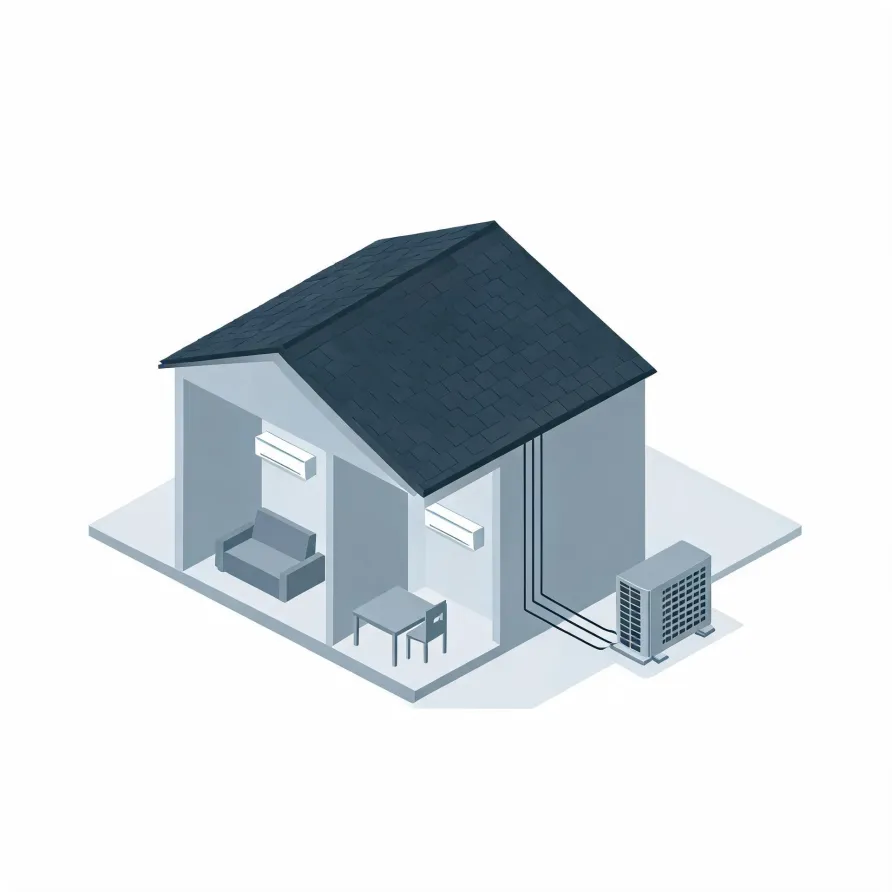
The indoor air handler mounts high on a wall inside the room and is the piece a homeowner sees every day. Its fan, coil, and filters all sit inside that cabinet, and any one of them can be the source of weak airflow, ice buildup, or odd smells. The outdoor condenser unit sits on a pad or bracket outside the house and holds the compressor, which is where a contractor often starts when the system runs but does not cool or heat.
A refrigerant line set runs between the two units through a small penetration in the wall, carrying the refrigerant that makes the whole system work. A condensate drain line runs from the indoor unit to the outside, and a blocked drain is one of the more common causes of water leaking into a room. The outdoor unit also holds a control board that governs how the two sides communicate.
The drawing shows the general layout of a mini-split system, and a licensed contractor determines which parts apply to the specific setup in your house.
Find a contractor in Treasure CountyTreasure County by the Numbers
48 severe weather events were recorded in Treasure County, Montana between 2015 and 2024.
NOAA National Centers for Environmental Information, Storm Events Database, bulk CSV export, events 2015-01-01 through 2024-12-31.Half the homes in Treasure County, Montana were built in 1972 or earlier (2020-2024 ACS 5-year).
U.S. Census Bureau, 2020-2024 American Community Survey 5-Year EstimatesTreasure County, Montana holds 460 housing units (2020-2024 ACS 5-year).
U.S. Census Bureau, 2020-2024 American Community Survey 5-Year EstimatesOwners occupy 68.3% of the occupied homes in Treasure County, Montana (2020-2024 ACS 5-year).
U.S. Census Bureau, 2020-2024 American Community Survey 5-Year EstimatesRepair Rules for Mini-Split Work in Treasure County, Montana2 codes, standards, and regulations
Licensing and Legal Requirements in Treasure County, Montana
Montana’s contractor licence does not reach a casual, minor or inconsequential job whose total price for labour, materials and everything else is less than $2,500 — and the exemption is lost if the work is only part of a larger operation, or if a job is divided up to get under the figure.
Montana requires a current construction contractor licence from the Department of Labor and Industry: an individual or business may not engage in business as a construction contractor without one.
Severe Weather Events in Treasure County by Year
Weather patterns in this part of Montana put real demands on heating and cooling equipment over time. A mini-split running hard through local conditions wears differently than one in a mild climate, which makes repair needs here specific to this place.
48 severe weather events, 2015–2024. Source: NOAA National Centers for Environmental Information, Storm Events Database.