Tell us about the job
Takes about a minute. No obligation.
A mini-split compressor sitting idle through most of the calendar and then asked to run hard on the first hot day of summer is where most failures in this county show up. Homes in Garfield County, MT run cooling about two months a year, from July through August. The compressor, the contactor, and the condenser fan see little cycling across the year, so faults that develop over winter go undetected until that first call in July. A contractor diagnosing a unit here checks the electrical components and the refrigerant charge before anything else, because those are what degrade during long idle periods rather than through heavy seasonal runtime.
Half the homes in Garfield County, Montana were built in 1978 or earlier (2020-2024 ACS 5-year). A house that old was not built with a mini-split in it. Whatever system first ran in it is gone, replaced by equipment installed years later, which means the building's age does not point a contractor toward the fault. What does is what the opened unit actually contains: whether the refrigerant circuit is holding charge, whether the control board is throwing codes that trace to a failed component, and whether the manufacturer still supplies that part. On stock this old, the house settled long before the equipment arrived.
The Parts of a Mini-split a Contractor Checks First
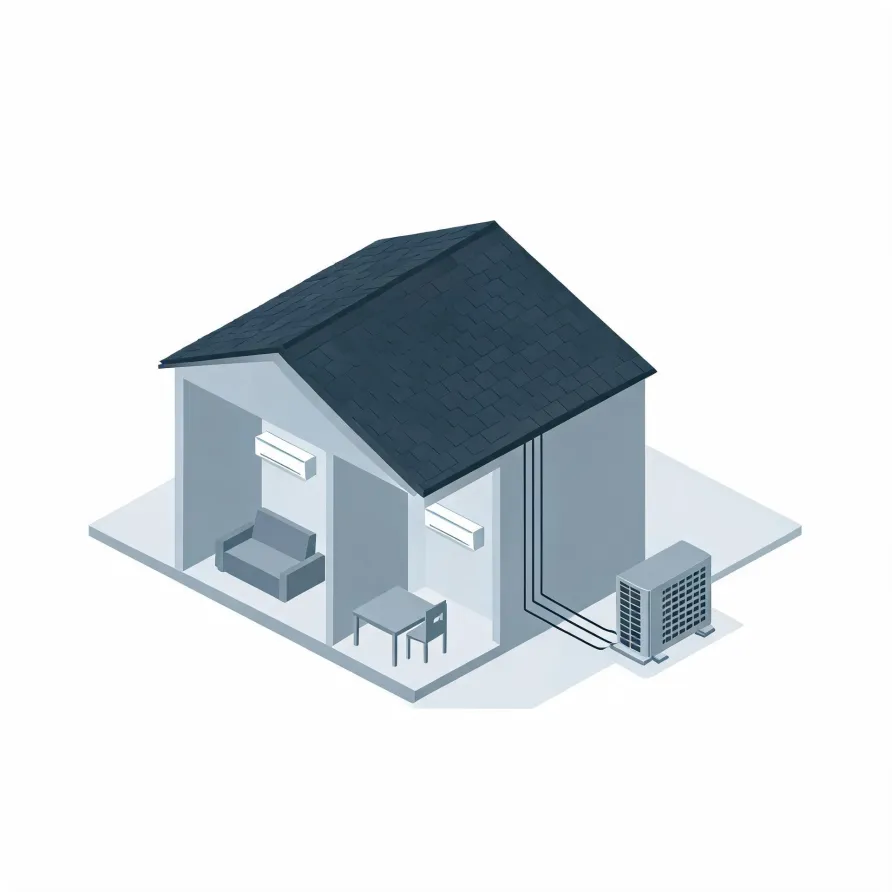
The indoor air handler is the piece most homeowners notice, mounted high on a wall inside the room it serves. It holds the evaporator coil, a blower fan, and the filter. When this unit is the problem, a room may stop cooling or heating altogether, or it may run but move little air.
Outside the house sits the condenser unit, which houses the compressor and the outdoor coil. A refrigerant line set and a control cable run through the wall to connect the two units. The compressor is the part a contractor reaches for when the system runs but cannot move heat, and the line set is checked when refrigerant loss is suspected.
The drawing shows a typical layout, and a licensed contractor determines what applies to your specific installation.
Find a contractor in Garfield CountyGarfield County, by the numbers
189 severe weather events were recorded in Garfield County, Montana between 2015 and 2024.
NOAA National Centers for Environmental Information, Storm Events Database, bulk CSV export, events 2015-01-01 through 2024-12-31.Half the homes in Garfield County, Montana were built in 1978 or earlier (2020-2024 ACS 5-year).
U.S. Census Bureau, 2020-2024 American Community Survey 5-Year EstimatesGarfield County, Montana holds 730 housing units (2020-2024 ACS 5-year).
U.S. Census Bureau, 2020-2024 American Community Survey 5-Year EstimatesOwners occupy 72.2% of the occupied homes in Garfield County, Montana (2020-2024 ACS 5-year).
U.S. Census Bureau, 2020-2024 American Community Survey 5-Year EstimatesCodes & Standards Governing Mini-Split Repair in Garfield County, Montana2 sourced rules & standards
Licensing and Legal Requirements in Garfield County, Montana
Montana’s contractor licence does not reach a casual, minor or inconsequential job whose total price for labour, materials and everything else is less than $2,500 — and the exemption is lost if the work is only part of a larger operation, or if a job is divided up to get under the figure.
Montana requires a current construction contractor licence from the Department of Labor and Industry: an individual or business may not engage in business as a construction contractor without one.
Severe Weather Events in Garfield County
Extreme weather puts real load on heating and cooling equipment, and that load accumulates over time. How hard the climate pushes in Garfield County shapes how hard the equipment works and how often repair becomes necessary.
189 severe weather events, 2015–2024. Source: NOAA National Centers for Environmental Information, Storm Events Database.