

Why your mini split blows cold air in Montana

One request and the search for a pro is handled.

Hand it off

Why is my mini split blowing cold air when it's set to heat?

You've got the thermostat set to heat and the unit is running, but what's coming out of the vents feels cold, not warm. That's not normal, and it's easy to assume the whole system is broken. Before you shut it off and call around, it helps to know what's actually going on, because a few causes are simple and others mean the unit needs a technician who knows this equipment.

A dirty filter, a low refrigerant charge, or a defrost cycle stuck on

Mini splits pull heat from the outdoor air even when it's cold outside, and that process needs a clean filter, a full refrigerant charge, and an outdoor coil that isn't iced over. A clogged filter blocks airflow so the indoor coil can't warm the air passing over it. Low refrigerant means the system can't move enough heat indoors no matter how hard it runs. And when the outdoor coil frosts up, the unit switches into defrost mode and blows cool air for a few minutes while it clears the ice, which is normal for a short stretch but not if it keeps happening. If cold air keeps coming out past that, the system needs a technician to check the charge and the coil before it struggles through a Montana winter unable to keep up.

A white wall-mounted mini-split indoor unit on a light gray interior wall, with a white curtain on a black rod at left and a leafy plant in the lower left corner.

Running the way it should

Air coming out of the vents is warm, the room is climbing toward the temperature you set, and the unit cycles on and off without you noticing it. No odd smells, no ice on the outdoor unit, no strange noise from the wall unit. This is what a mini split looks like when nothing needs attention.


A wall-mounted white mini-split air conditioner indoor unit with visible dust and grime around its outlet vent, installed near the ceiling on a plain light-colored wall.

Dirty and struggling

Dust has built up along the vents and across the casing edges, and the airflow coming through feels weaker than it used to. A unit in this state can run and still fail to heat the room, because the coil and filter behind that grime can't move heat the way they're supposed to. This is worth having someone look at.

A gray-haired man in a dark long-sleeve shirt sits on a gray sofa in a living room, looking toward a sunlit window with sheer curtains.
A gray-haired man in a dark green sweatshirt sits on a sofa in a living room, looking toward a bright window, with a houseplant, lamp, fireplace and framed art behind him.
A gray-haired bearded man in a dark green collared sweater sits on a sofa in a living room with a window, houseplant, floor lamp and bookshelves, looking off to the side.
A gray-haired man in a dark green sweater sits on a sofa in a sunlit living room, looking off to the side, with a framed landscape painting, dining table and shelving behind him.

What the defrost cycle is doing

A mini split pulls heat from the outside air even when it's well below freezing, and that frost builds up fast on the outdoor coil. Every so often the system reverses itself for a few minutes, running like an air conditioner to melt that frost off the coil. During that time the indoor unit is blowing air that hasn't been heated, sometimes outright cold. The outdoor fan usually stops too, and you might hear a change in sound. If this happens for a short stretch and then the unit goes back to blowing warm, that's the defrost cycle working as designed.

When cold air means something failed

A single defrost cycle lasting several minutes is normal in a Montana winter. Cold air that doesn't stop, or that starts the moment you turn the system on, points to something else. A low refrigerant charge means the unit can't move enough heat regardless of what the thermostat says. A failed reversing valve can leave the system stuck in cooling mode no matter how you set it. Either one needs a licensed technician with gauges and training on that equipment, not a guess. A local pro who works on these units all winter will know which of the two is more likely given how your system is acting.

A wall-mounted mini-split air conditioner indoor unit with visible dust and staining, installed on a beige interior wall below white crown molding.
Before you get your mini split repair
A white wall-mounted mini-split indoor unit high on a beige interior wall, with a potted olive-like tree at right and an armchair and window visible through a doorway at left.
After you get your mini split repair

Hand off the mini split problem

A mini split blowing cold air in a Montana winter is not something to sit on. If the outdoor unit is iced over and not clearing, or the wall unit runs cold no matter what you try, that's a repair, not a wait-and-see. Mini splits aren't the main heat source in most homes around here, gas furnaces carry that load, but if you're leaning on yours for a bedroom, a bonus room, or a space the furnace doesn't reach well, losing it matters. Finding someone who works on these units regularly isn't always simple here. They're not every contractor's bread and butter the way a furnace is, and the person who services them week in and week out knows the usual reasons one runs cold and how to check them fast. Send the request and that search is off your plate. One local contractor gets it, not a handful competing for your call, and you can get back to a house that's actually warm.

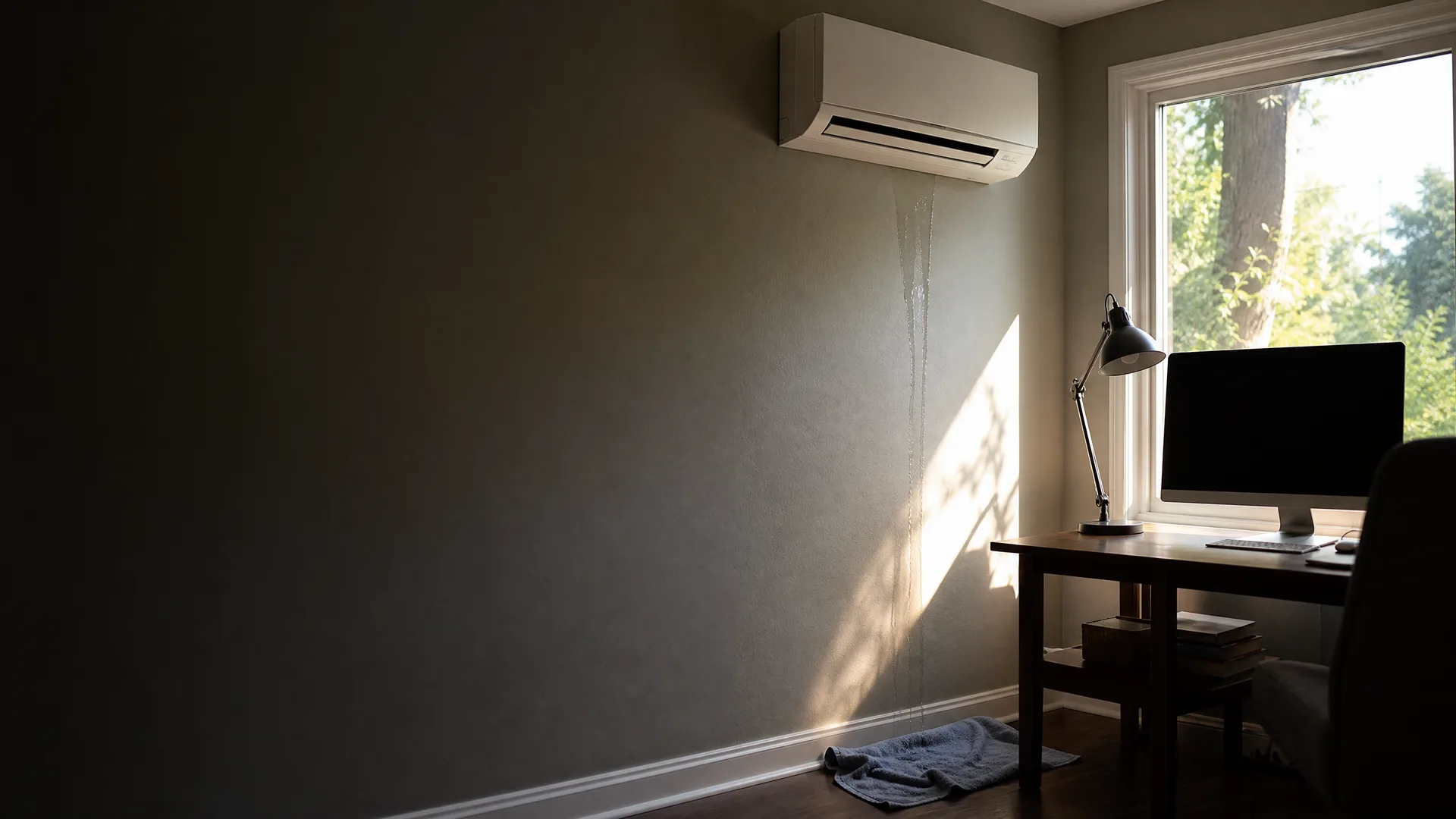
A wall-mounted mini-split air conditioner leaking water down a dim gray wall onto a towel on the floor, beside a window with a desk, lamp and monitor.

You're at the desk in the office in the middle of the afternoon, working with the mini split blowing what should be warm air on a day cold enough that you've had it running since morning. You notice the wall under the indoor unit looks dark. A streak has run down from the bottom of the unit to the baseboard, and when you touch it, it's wet. You grab a towel off the bathroom rack and lay it along the floor under the wall, then stand back and watch the unit for a minute, listening for the fan, trying to tell if the drip is still coming.

Power costs 12.99 cents per kilowatt-hour statewide

At 12.99 cents a kilowatt-hour, running the mini split while it hunts for warm air isn't the expensive part of your winter. Montana power is cheap enough that the real cost is staying cold while a stuck defrost cycle or a bad sensor keeps it from ever switching back to heat.

EIA-861 2025 statewide residential average

A woman with shoulder-length dark brown hair in a cream knit cardigan sits in an upholstered armchair beside a window, looking off to the side, with a white bookshelf and potted plant blurred behind her.
A woman with dark hair in a bun sits wrapped in a chunky knit blanket on a couch with a child resting his head on her shoulder, eyes closed, beside a lit lamp and bookshelf indoors.

What this comes down to

  • Cold air from the vents on heat mode means a defrost cycle stuck on or a failed sensor, not a dead system.
  • Most of the mini split's parts, wiring and refrigerant lines are outside work, not something to open up yourself.
  • A tech who services mini splits through a Montana winter has seen this exact complaint many times before.
  • Gas furnace backup can cover the house while the mini split gets sorted, so there's no need to rush a decision out of discomfort.
  • One licensed, local contractor takes the call, so you're not sorting through bids from companies that don't know your equipment.
  • Ice on the outdoor unit that won't clear on its own is a sign to get someone out, not a sign to wait through another cold snap.

A mini split blowing cold air on heat mode in Montana almost always traces back to the defrost cycle or a sensor that's telling the system the wrong thing. It's not a sign the unit is finished. The outdoor coil ices up in cold, dry air the same way every winter, and the fix for that lives outside, in the refrigerant lines and controls that aren't meant for a homeowner to get into. That's where a local contractor earns the call. Someone who works on these systems through a full Montana winter has already seen a wall unit running cold on a January afternoon, has already traced that exact complaint back to a stuck reversing valve or a failed thermistor, and knows which one it usually is before they pull the cover off. You're not the first house they've been to with this problem this season.

There's no reason to push through a few cold days waiting for it to fix itself. If the gas furnace is still covering the house, the mini split can wait for a real appointment instead of an emergency one, but ice on the outdoor unit that isn't melting off on its own is worth getting looked at. When you send the request, it goes to one licensed contractor who knows this equipment, not a handful of companies competing for the job. You make one call's worth of effort and the search for who does it stops being yours to carry.

A modern two-story house with dark siding and stone base at dusk, with lit soffit lights, a path of large rectangular pavers set in dark gravel, planting beds, a lawn, and an orange and blue sunset sky above distant trees and water.

Mini Split Repair

Hand off the search today

Step 1 of 3: Equipment
  • A cream upholstered armchair with a textured pillow sits in a corner beside a small round wooden side table holding a vase of greenery and a book, under a framed landscape print, with a potted tree in a woven basket and a sheer curtain nearby.
    • Tell a local repair pro what your mini split is doing.
    • A local pro who knows mini splits gets your details and gets in touch.
  • A beige upholstered armchair with a green cushion and knitted fringed throw sits in a corner beside a wooden side table holding a stone vase of leafy branches, under a framed landscape picture, on a woven rug near a sheer curtain.
    • Get the mini split repair search off your mind today.
    • Once you send the form, finding a pro is off your list.
  • A wood-framed armchair with light beige upholstery and a gray linen cushion sits in a corner beside a potted olive-like tree and a sheer curtain at a window, with a framed picture on the wall above.
    • Explain the job once and skip repeating it on every call.
    • Skip searching for a mini split pro and answer a few questions instead.
  • A ceramic vase holding leafy branches sits on a round wooden side table beside a sofa with a dark green cushion and gray throw, next to a sunlit window.
    • Only one pro gets your request, so you hear from one company.
    • Your request stays with one local pro.