Why your mini split has ice on it in a Montana winter

Step 1 of 3: Equipment

Ice on the outdoor unit in winter usually means the mini split is still working, just fighting the cold. Montana winters put the outdoor coil below freezing for long stretches, and any heat pump pulls moisture out of that cold air. That moisture turns to frost on the coil. A normal defrost cycle melts it off every so often, and you might see steam coming off the unit while that happens. If the ice keeps building instead of clearing, something is stopping that cycle from working, a fan that has slowed down, a sensor giving a wrong reading, or a refrigerant charge that has dropped. At that point the unit cannot shed heat the way it needs to, and running it iced over stresses the compressor. A little frost that melts on its own is normal. Ice that stays thick or keeps coming back after a defrost cycle is not, and it is worth having someone look at before it causes a bigger failure.

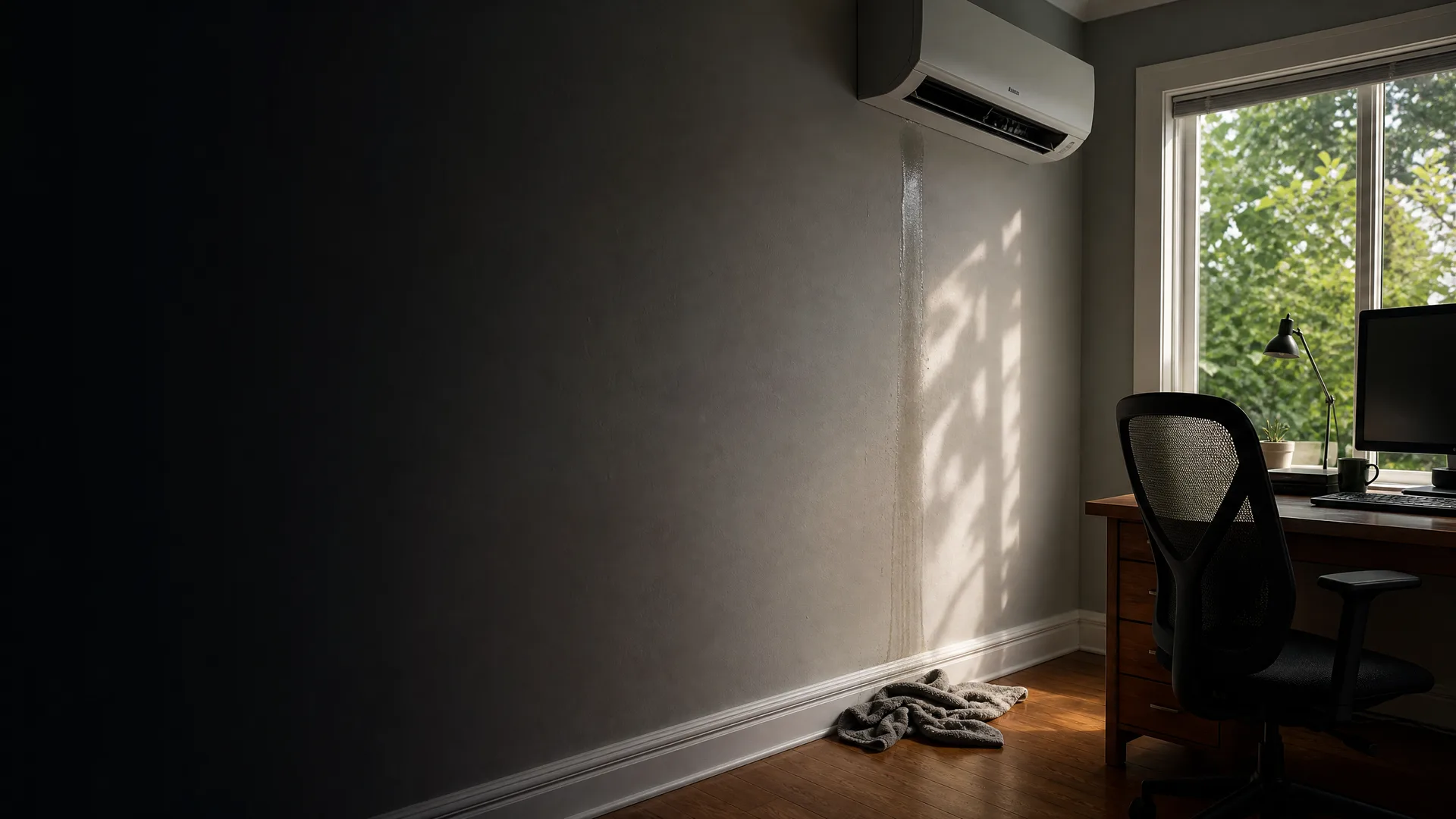
A wall-mounted mini-split air conditioner in a dim room, with a water streak running down the wall below it to a towel on the floor near the baseboard, beside a desk, office chair and monitor by a window.

You're at your desk in July, the afternoon sun hitting the window, and you notice the wall under the indoor unit looks dark. You get up and find a wet streak running down the drywall, pooling at the baseboard. You grab a towel from the hall and press it against the wall, then look up at the unit. It isn't dripping now, but the streak is already dry at the edges, like it's been running for a while. You open the windows, the dry Montana air doing nothing to explain what you're looking at. The office smells faintly damp. You turn the mini split off at the wall and stand there, towel in hand, wondering how long this was happening before you walked in.

Normal Frost or a Problem

Normal Frost

  • A thin, even layer of frost across the outdoor coil during a cold snap is part of how a heat pump runs in freezing air.
  • The unit should run a defrost cycle on its own every so often, sending warm refrigerant through the outdoor coil to melt that frost off.
  • You'll hear the outdoor fan stop and see steam or water coming off the unit for a few minutes, then it goes back to normal.
  • Snow or frost on the top and sides of the cabinet, where it's just sitting on the metal, isn't the same thing as ice building up on the coil itself.
  • If the unit clears itself within twenty or thirty minutes and goes back to heating your home, it did what it was built to do.

Needs a Look

  • Ice that keeps building instead of clearing, or a block of ice thick enough to cover the coil fins, means the defrost cycle isn't working right.
  • A unit buried in ice while the indoor side blows cold air instead of warm is no longer heating your home the way it should.
  • Ice forming even on milder days, not just during the coldest stretches, points to a problem with the unit rather than the weather.
  • A low refrigerant charge, a failed defrost sensor, or a fan that's not clearing snow away from the coil can all keep frost from melting off.
  • Running a unit like this through the rest of a Montana winter risks damage to the compressor, which costs far more to deal with than the ice itself.
  1. Outdoor coil temperature drops below freezing as the heat pump runs.

  2. Moisture in the outside air lands on the coil and turns to frost.

  3. The control board tracks coil temperature and run time between cycles.

  4. Once the trigger point hits, the unit reverses into defrost mode.

A woman in a cream cowl-neck sweater sits by a window with snow outside, in a dimly lit living room with a sofa, lit lamp, mirror, candles and a fireplace.
A woman in a gray turtleneck sweater sits beside a large window looking out at snow-covered evergreen trees, in a dimly lit living room with a lit fireplace, lamps, couch and houseplant.
A woman in a cream turtleneck sweater stands beside a large window with snow-covered ground and bare trees outside, in a dimly lit living room with lamps, a sofa and framed art.
A woman in a grey cowl-neck sweater stands indoors near a window, looking out at falling snow, with a lamp, framed picture and couch in the warmly lit room behind her.

A mini split is supposed to clear its own frost. Every so often the system reverses itself for a few minutes, sends warm refrigerant out to the coil, and shuts the outdoor fan off while it melts what built up. That's normal and you'll see steam come off the unit when it happens. Problems start when that cycle runs and the frost doesn't go away, or doesn't trigger at all. The reversing valve might be sticking, so the system can't actually switch into defrost even though the board calls for it. A coil caked with dirt holds frost longer because less air gets to the metal to warm it back up. If the refrigerant charge is low, the coil runs colder than the board accounts for, so frost piles on faster than the system is built to handle. There's also a sensor on the coil that tells the board how cold it is. If that sensor fails and reports a warmer reading than reality, defrost never gets called at all. Snow packed against the unit causes the same result by blocking the airflow defrost depends on.

Why defrost sometimes fails

  • A defrost cycle normally runs for a few minutes and the outdoor fan stops while the coil clears.
  • If frost keeps building after a defrost cycle finishes, the reversing valve may not be switching the way it should.
  • A dirty outdoor coil holds frost longer because less outside air can reach the metal to warm it.
  • Low refrigerant charge drops coil temperature further than it should go, so frost forms faster than the control board expects.
  • A failed sensor on the outdoor coil can tell the board the coil is warmer than it is, so defrost never triggers.
  • Snow or ice packed against the outdoor unit blocks airflow and frost spreads instead of clearing on schedule.
A wall-mounted mini-split air conditioner indoor unit with a dusty, discolored cover, installed near the ceiling on a plain light-colored wall.
Before you get your mini split repair
A white wall-mounted mini-split air conditioner unit installed high on a light gray interior wall below crown molding, with a bamboo-shaded window at the lower left.
After you get your mini split repair
Living room with a grey sectional sofa, wall-mounted white mini-split air conditioner above it, a potted tree beside sliding glass doors with beige curtains, and a wooden coffee table with a vase of foliage in the foreground.

Get the right pro for your mini split

Your request stays with one local pro.

Describe your mini split job, and a local pro who handles it gets in touch.

Request a pro

Sending the form costs nothing.

What are you seeing when you check the outdoor unit

Walk out and look at the outdoor unit after a stretch of single digit nights. If the frost is a thin white coating that clears on its own within an hour or two, that's normal. What you're asking about is different. Maybe the coil is caked in a solid sheet of ice, thick enough that you can see it from the window. Maybe ice has built up on the base pan and crept up into the fan blades, or the fan isn't turning at all. Indoors, the vents might be pushing air that feels barely warm, or the unit is running non-stop and the house still isn't holding heat. Left alone through a hard Montana cold snap, that ice can crack the fan blade or strain the motor, and you'd be without heat until it's fixed.

A white wall-mounted mini-split air conditioner installed high on a beige interior wall below crown molding, with a window and light curtain on a black rod at right.

Working as it should

The coil cycles through its defrost runs and clears on its own, so the frost never gets the chance to build. The cabinet stays clean because nothing is dripping or breaking down inside it. Indoors, the unit puts out steady heat without the outdoor fan icing up or stalling.

A wall-mounted mini-split air conditioner indoor unit with a dusty off-white casing and dark lower vent, installed high on a plain light-colored wall below a ceiling molding.

Ice building up

A dusty, discolored cabinet like this one often points to a coil that isn't shedding heat the way it should, which makes frost harder to clear between defrost cycles. Grime on the coil and housing holds moisture longer and slows airflow. Left alone, the ice keeps adding up instead of melting off.

A woman in a cream sweater and jeans stands in the open doorway of a white stucco house, holding the dark door, while a man in a dark quilted jacket seen from behind walks toward the entry past potted plants.

What a frozen mini split means for your house

A coil that stays iced over doesn't just lose efficiency. Once the frost gets thick enough, it packs against the fan blade and the cabinet panels, and the ice has to go somewhere when it melts. That's water running down the outside wall, pooling against the foundation, or dripping into the base pan where it can crack with the next freeze. Inside, the room that unit heats runs colder than the thermostat says, and you'll likely catch yourself turning up the gas furnace to make up the difference.

Montana winters don't let a stuck defrost cycle fix itself. Left alone through a cold snap, a frozen outdoor unit can strain the compressor trying to push heat through a coil that can't absorb any. A local contractor who services mini splits through winters like this one will know whether what you're looking at is the reversing valve, a low charge, or a fan that's slowed down enough to stop clearing frost on schedule. Getting matched with one tech means a single call, not a string of them, from someone who's already seen this fail in this kind of cold.

Interior corner with a beige sofa holding a dark green and a light cushion and a textured throw, a potted small-leaved tree beside a white-framed window, and a dark shallow bowl on a wooden coffee table in the foreground.
A two-story house with gray and light gray siding, white-trimmed windows and a white front door, flanked by deciduous trees, with a partly browned lawn in front under a clear blue sky.

That ice you're checking on the outdoor unit isn't about summer, but the two aren't unrelated either. Montana summer air carries a dew point around 44°F, measured across June, July and August. That's dry air. It means your mini split barely works for moisture half the year, so by the time winter sets in, the coil and drain haven't had much practice shedding water. A coil that doesn't clear well in July is often the same one that builds ice faster once the temperature drops and stays down.

NASA POWER T2MDEW county cells weighted by homes

A white wall-mounted mini-split air conditioner installed high on a beige interior wall near the ceiling, with a white-framed window at the left edge.
The coil shows a thin white coating after a cold snap, and the cabinet stays dry and quiet.
A dusty, stained wall-mounted mini-split air conditioner indoor unit near the ceiling on a plain beige wall, with visible lint buildup at its intake grille.
Dust and dark grime cake the casing and filter, and the coil underneath is holding ice it never sheds.

Power costs 12.99 cents per kilowatt-hour statewide

At 12.99 cents a kilowatt-hour, running the outdoor fan through extra defrost cycles costs little. A mini split icing up and clearing on its own won't move your bill much. A coil that stays frozen and makes the compressor work harder against it is a different story.

EIA-861 2025 statewide residential average

What the ice on your unit tells you

  • A thin coat of frost that clears within an hour or two of a cold snap is the mini split doing its job.
  • Ice that keeps building after each defrost cycle points to a specific failure, not normal winter operation.
  • Checking the outdoor unit after single digit nights tells you more than waiting for the indoor side to lose heat.
  • A coil that stays frozen strains the compressor and can send water into the cabinet and the wall below.
  • A local contractor who services mini splits through Montana winters has already seen what usually causes this.
  • One contractor means one visit scheduled around your equipment, not a string of calls from companies that don't know your system.

A little frost after a cold night is just your mini split clearing itself the way it's built to. Ice that stays, that thickens after every defrost run, is the mini split telling you something specific is wrong, not that Montana winter is too much for it. The check is simple: walk out after a hard freeze, look at the coil, see if it clears. That's the whole answer this page came to give you.

What you do with it depends on what you find. If the frost is thin and gone by afternoon, there's nothing to fix. If it's building, you're looking at a reversing valve, a low charge, a coil that can't shed heat because it's packed with dust, or a sensor telling the board the wrong thing. Those aren't problems you diagnose from the kitchen window. They're problems someone who works on these units all winter can usually spot fast, because they've already seen the same failure on another unit a few miles from yours in the same cold.

That's who gets matched to you, a licensed contractor working near you who services mini splits through winters like this one, not a call center routing you to whoever's free. One contractor means one visit, scheduled around your unit and what it's actually doing, instead of fielding a handful of calls from companies guessing at the problem over the phone. You've done the hard part already by checking the coil instead of waiting for the house to go cold. The next step is getting someone out who knows what that ice usually means before they even open the cabinet.

A white wall-mounted mini-split indoor unit on a light gray wall above a beige sectional sofa with a patterned cushion, beside a framed abstract artwork and a curtained window.

A pro who works on mini splits

Reach a local pro

Your request goes to one pro, not a list of companies.

You're not committing to anything by asking.